Hard Court Solutions for Every Property Type in DFW
The Dallas-Fort Worth Metroplex encompasses an extraordinary range of property types, from compact suburban lots in Plano and Richardson to expansive ranch estates west of Weatherford, and Tour Greens Dallas has the expertise to design and install a high-performance hard court on virtually any of them. A professionally constructed hard court provides a permanent outdoor recreation surface that serves families, neighborhoods, and organizations for decades. Whether the goal is a private basketball court for weekend pickup games, a regulation pickleball facility for a retirement community, or a commercial-grade multi-sport complex for a corporate campus, our DFW team delivers a turnkey solution that handles every detail from earthwork through final accessory installation.
Tour Greens Dallas operates as a certified installer for VersaCourt modular court tile systems and SportMaster acrylic sport coatings, and our sister brand Celebrity Courts extends our capabilities to include the full spectrum of hard court construction techniques used throughout the North Texas market. This breadth of product knowledge means we never force a one-size-fits-all solution on a client. Instead, we evaluate each property's unique characteristics, including lot size, soil conditions, existing hardscape, intended sports, and budget, then recommend the surfacing approach that delivers the best combination of playability, durability, and long-term value. Contact our DFW project team at 214-367-5313 to begin your consultation.
Modular vs. Poured: Choosing the Right Surface Technology
DFW property owners face a fundamental choice when planning a hard court: modular interlocking tiles or a poured-and-coated acrylic surface. Each technology carries distinct advantages depending on the project scope and site conditions. VersaCourt modular tiles consist of injection-molded polypropylene squares that click together over any flat, structurally sound substrate. Installation is rapid because tiles require no adhesive, curing time, or specialized equipment. The suspended tile profile creates a sub-surface air channel that promotes drainage and provides a degree of impact cushioning that players notice immediately. Modular systems also offer simple maintenance since a damaged tile can be popped out and replaced in seconds without affecting the surrounding surface.
Poured acrylic systems applied by our SportMaster-certified crews produce a seamless, traditional court surface favored by tennis players and those who appreciate the polished aesthetic of a painted court. The application process involves preparing the concrete substrate through diamond grinding or shot-blasting, applying a filler coat to level minor imperfections, building up textured acrylic layers for traction, and finishing with two coats of UV-resistant color. Cushioned acrylic systems add elastomeric rubber layers beneath the color coats to reduce leg fatigue and joint stress. For DFW properties that already have an existing concrete pad, a full-depth concrete overlay bonded to the original slab can transform a worn patio, old basketball pad, or underused parking area into a brand-new court surface without the expense and timeline of full demolition and re-pouring.
From Basketball to Futsal: Sport Applications Across DFW
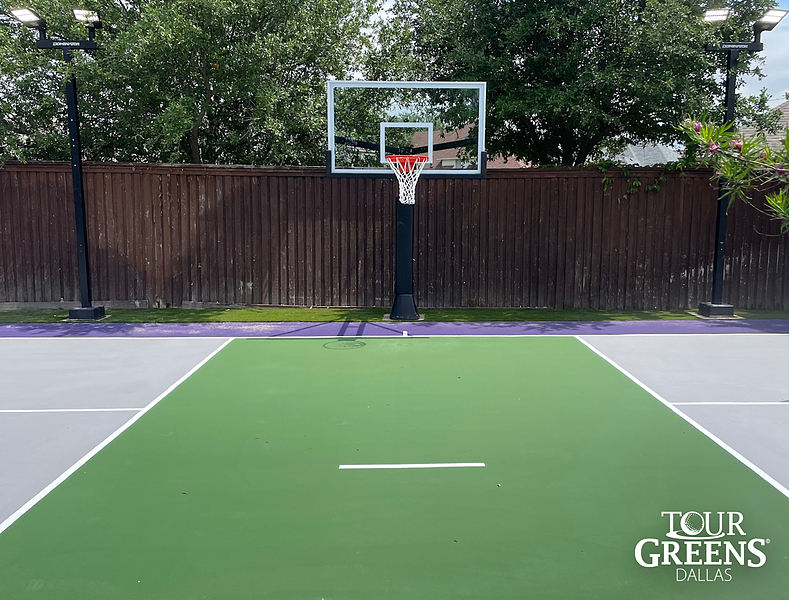
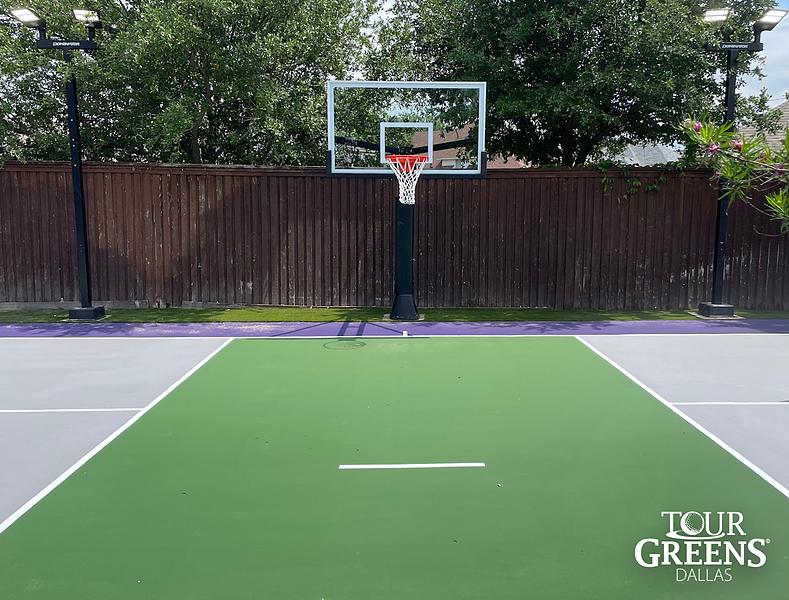
The diversity of athletics practiced across the DFW Metroplex translates directly into the variety of court configurations our team installs. Basketball courts account for the largest share of residential projects, with half-court and full-court options scaled to fit properties ranging from standard Frisco subdivisions to multi-acre McKinney estates. We supply and install adjustable-height goal systems, fan-shaped backboards, and breakaway rims that meet NCAA and NBA specifications depending on client preference.
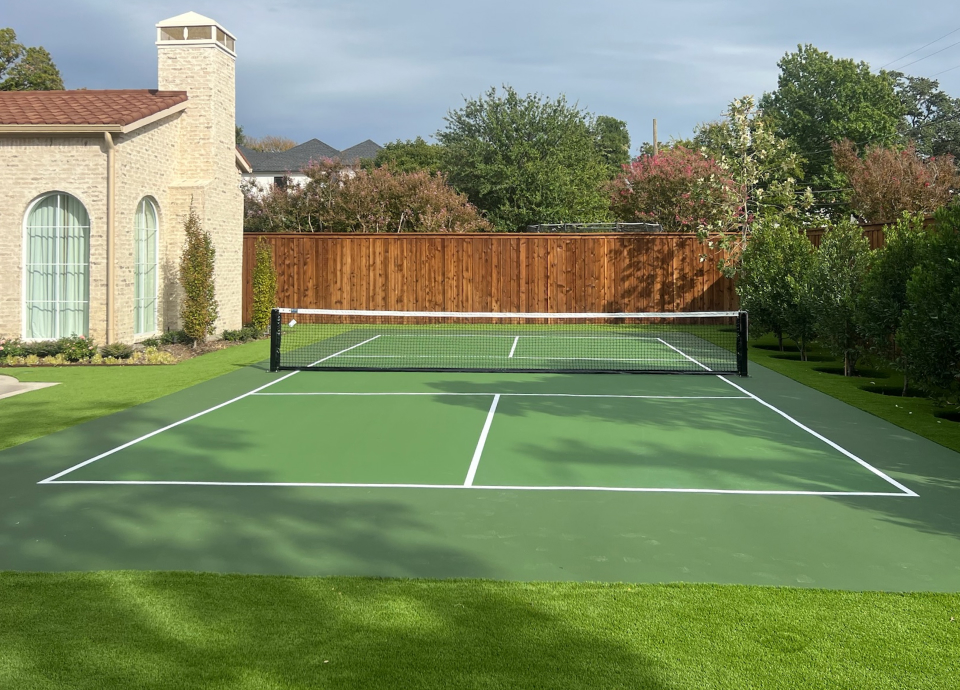
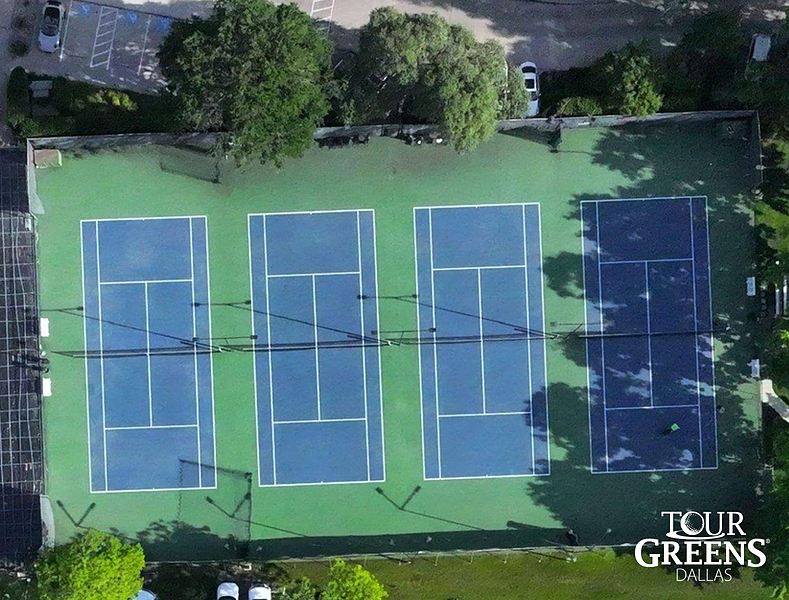
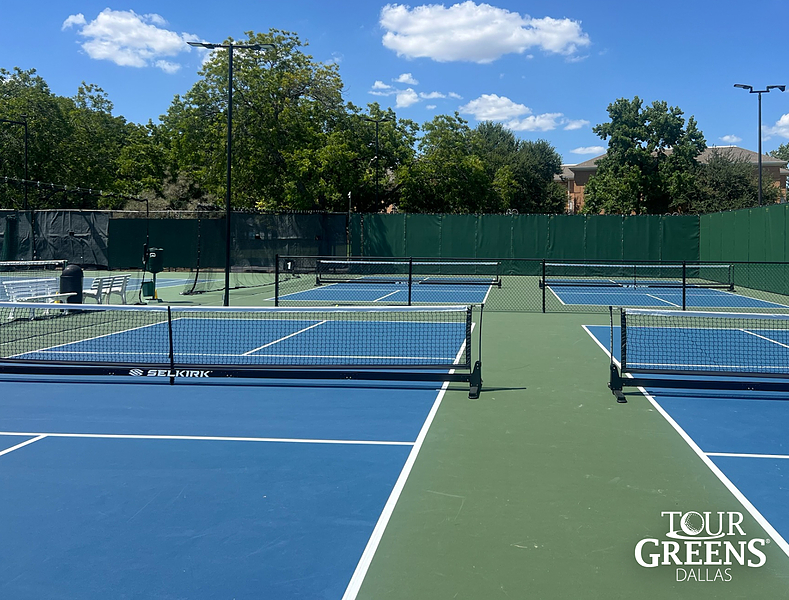
Pickleball court construction has accelerated sharply throughout North Texas, driven by growing participation among active adults and the sport's compatibility with smaller lot sizes. A dedicated pickleball court requires only 30 by 60 feet including recommended overrun space, making it feasible for backyards where a full tennis court would not fit. Tennis installations follow International Tennis Federation dimensional standards, and clients can select from fast, medium, or slow surface speeds by adjusting the aggregate size in the acrylic texture coat. Multi-sport configurations remain our most versatile product. A single court footprint of approximately 50 by 80 feet can incorporate basketball, dual pickleball, short-court tennis, and badminton lines using a color-coded marking system that keeps each game intuitively separated. We also build futsal courts with regulation markings for the DFW area's thriving youth soccer programs, along with roller hockey surfaces fitted with perimeter dasher boards and player benches for league and recreational play.
Custom Design for DFW Hard Court Projects
Every Tour Greens Dallas hard court project begins with an on-site property assessment conducted by an experienced court designer. We document the lot dimensions, measure grade differentials across the proposed build area, identify underground utilities and drainage easements, and photograph the surrounding landscape to understand how the court will integrate visually with existing structures and hardscape. The resulting design package includes dimensioned CAD drawings, color-rendered plan views, and a written scope of work detailing every material, accessory, and construction step involved in the project.
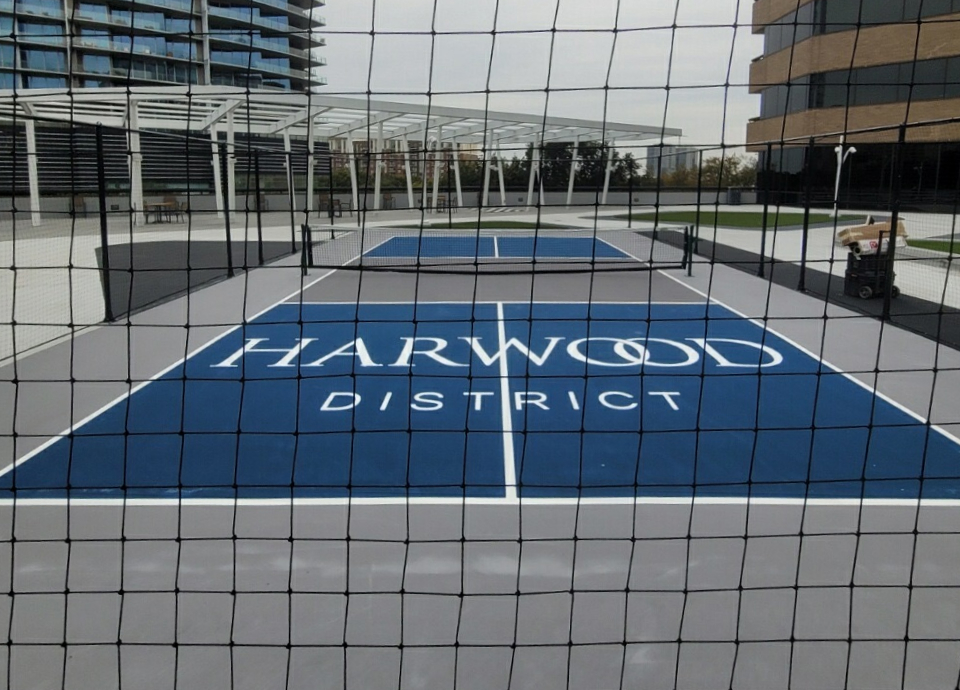
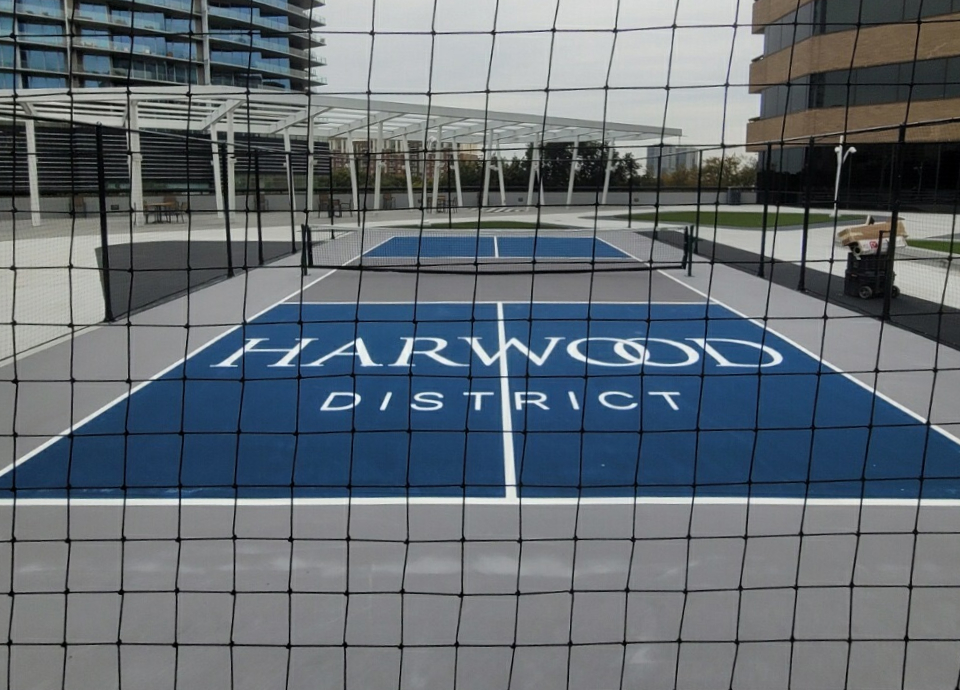
DFW clients choose from an extensive palette of court surface colors. VersaCourt tiles are available in 18 standard tones, while SportMaster acrylic coatings offer over 30 hues that span traditional sport colors and contemporary architectural shades. Contrasting color zones can delineate different game areas, highlight three-point arcs or service boxes, or create a bordered perimeter that frames the court within the broader landscape. Custom graphics including team logos, university crests, family initials, and corporate branding can be painted onto acrylic surfaces or built into modular tile layouts using pre-colored tile patterns. Line markings for each sport are applied by our trained striping crew using precision templates and commercial-grade paint that bonds permanently to the surface. LED court lighting, fencing, wind screens, net systems, and rebounders complete the installation and deliver a facility ready for competitive or recreational play day and night.
Durability & Maintenance for DFW Hard Courts
The DFW Metroplex climate swings between summer highs above 105 degrees and occasional winter lows in the teens, and this thermal range puts significant stress on any outdoor surface. Tour Greens Dallas mitigates these forces through engineering practices calibrated to local soil and weather conditions. All of our concrete sub-bases are a minimum of four inches thick using 3,500-PSI concrete with steel reinforcement. Where the project sits on the expansive black clay soils found across much of Collin, Dallas, and Denton counties, we specify thickened-edge slabs or post-tensioned designs that accommodate soil heave without cracking. A compacted aggregate base layer beneath the slab ensures positive drainage and prevents the subgrade from softening during wet periods.
Surface maintenance requirements for DFW hard courts are intentionally low. VersaCourt tiles need only periodic debris removal with a blower and an annual rinse with a garden hose or low-pressure washer. Acrylic courts benefit from quarterly sweeping or blowing to remove sand, pollen, and leaf litter, plus an annual wash with a mild detergent and soft broom. We recommend scheduling a professional surface inspection every three to four years so our team can identify and address any hairline cracking, texture wear, or color fading before it progresses. Full recoating of acrylic surfaces is typically needed every six to nine years in the DFW market, depending on direct sun exposure and play frequency. Both surface types carry manufacturer warranties, and Tour Greens Dallas stands behind every installation with our own workmanship guarantee that covers structural and surface defects.
Hard Court FAQs for DFW Property Owners
How do hard court costs compare by surface type in the DFW market?
Pricing varies based on court size, surface selection, site preparation complexity, and accessory packages. As a general guideline for the DFW area, VersaCourt modular tile systems installed over an existing concrete pad start in the range of six to nine dollars per square foot for the tile and installation labor alone. SportMaster acrylic coatings applied over an existing slab run approximately three to five dollars per square foot for a standard two-color, single-sport layout. If new concrete work is required, the sub-base typically adds eight to twelve dollars per square foot depending on soil conditions and accessibility. Cushioned acrylic tennis surfaces and post-tensioned slabs for clay-soil sites carry premiums above these baseline figures. We provide detailed, itemized proposals for every project so clients can compare options transparently.
What is the typical installation timeline for a DFW hard court?
A complete hard court project in the DFW Metroplex, including site grading, concrete work, surface installation, and line striping, generally takes three to five weeks from ground-breaking to completion. The concrete slab requires at least seven days of cure time before any surface treatment can be applied. VersaCourt tile installation over a cured slab can often be completed in a single day for a standard residential court. Acrylic coating systems need three to five days for multi-layer application and curing between coats. Weather delays are the primary variable since concrete cannot be poured during active rain and acrylic coatings require ambient temperatures above 50 degrees and no precipitation in the forecast for 24 hours. Our project managers build weather contingency into every schedule to set realistic expectations.
What are the practical differences between modular tiles and acrylic surfaces for DFW courts?
Modular VersaCourt tiles provide superior drainage, easier single-tile repairability, marginally better shock absorption, and faster installation. Acrylic coatings deliver a smoother, more traditional playing surface preferred by tennis enthusiasts, offer a wider range of custom color options, and tend to cost less per square foot when applied over an existing slab. Acrylic surfaces play slightly faster because the ball skids more on the smooth texture, while tiles produce a slightly slower, higher-bouncing ball response. For multi-sport family courts where drainage and durability are priorities, we lean toward tiles. For dedicated tennis courts or budget-conscious projects over existing concrete, acrylic coatings typically deliver the best value.
What warranty coverage applies to Tour Greens Dallas hard court installations?
VersaCourt modular tile systems carry a manufacturer warranty of 15 years covering material defects, UV degradation, and structural integrity of the interlocking mechanism. SportMaster acrylic coatings are backed by a manufacturer product warranty that covers adhesion failure, abnormal peeling, and premature delamination for a period consistent with the expected recoating cycle. Tour Greens Dallas supplements these product warranties with our own workmanship guarantee covering the concrete sub-base, grading, drainage, tile installation, coating application, and line striping. The specifics of each warranty are outlined in the project contract, and our team is available to address any warranty claims promptly throughout the coverage period.
Can a single DFW hard court accommodate multiple sport line layouts without looking cluttered?
Yes, and preventing visual clutter is one of the primary objectives of our line-design process. We accomplish clean multi-sport layouts through strategic use of color contrast, line weight variation, and spatial planning. The dominant sport receives the widest, most prominent line color, typically a bold white or yellow. Secondary sports are marked in progressively thinner lines using colors that coordinate with the court surface but remain clearly distinguishable during play. A typical four-sport layout uses four different line colors. We also position game boundaries to overlap as little as possible, which requires careful dimensional planning during the design phase. Our CAD drawings allow clients to visualize exactly how the finished multi-sport layout will appear before any paint touches the surface.
What type of foundation does a new hard court require in the DFW area?
New hard court construction in the DFW Metroplex begins with excavation of the topsoil layer and any organic material within the court footprint. We then place and compact a minimum of four inches of crushed limestone aggregate to create a stable, well-draining base. The concrete slab is poured at a minimum thickness of four inches using structural-grade concrete with welded wire mesh or rebar reinforcement. Control joints are cut at regular intervals to manage shrinkage cracking. On properties with high-plasticity clay soils, which are common across the central and eastern portions of the Metroplex, we may specify a six-inch slab, post-tensioned cable reinforcement, or moisture-barrier membranes beneath the aggregate base to prevent soil-moisture-driven heave from damaging the finished court. Every foundation design is tailored to the specific geotechnical conditions documented during our initial site assessment.
Our Work