
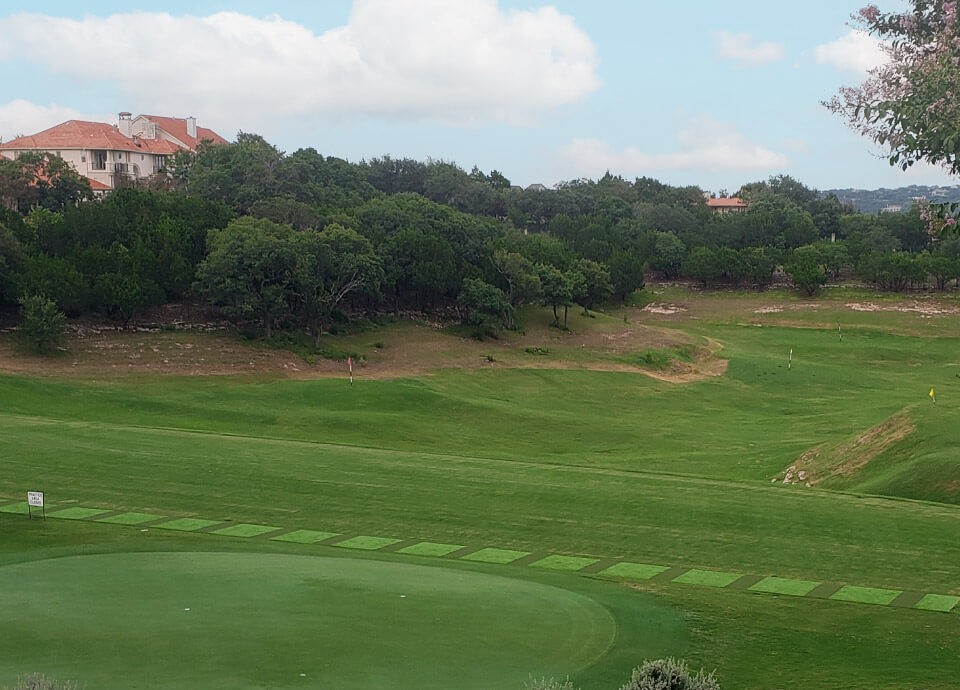
Water-Smart Tee Line Solutions for the DFW Metroplex
The Dallas-Fort Worth Metroplex has become one of the fastest-growing golf markets in the country, with new courses, practice facilities, and residential golf amenities appearing across North Texas at a remarkable pace. But maintaining natural grass tee areas in this region is an expensive, water-intensive proposition. North Texas water restrictions, scorching summer temperatures, and unpredictable freeze events make natural tee boxes a liability rather than an asset. Tour Greens Dallas provides synthetic tee line turf that eliminates irrigation requirements entirely while delivering a playing surface that rivals the best-maintained natural grass tees anywhere in the state.
A tee line refers to the narrow strip of turf where golfers position themselves to strike balls toward a target — whether on a commercial driving range, a backyard practice setup, or inside a golf simulator enclosure. This zone bears the brunt of every practice session, absorbing full-speed club impacts that would destroy natural turf within days of heavy use. Synthetic tee line turf from Tour Greens Dallas is purpose-built for this abuse, constructed from dense, resilient fibers that allow the clubhead to pass through cleanly without tearing, matting, or leaving permanent marks. Across the Metroplex — from Plano and Frisco in the north to Arlington and Grand Prairie in the south — our tee line installations serve golf enthusiasts who demand a professional-quality practice surface available every day of the year without a single drop of irrigation water.
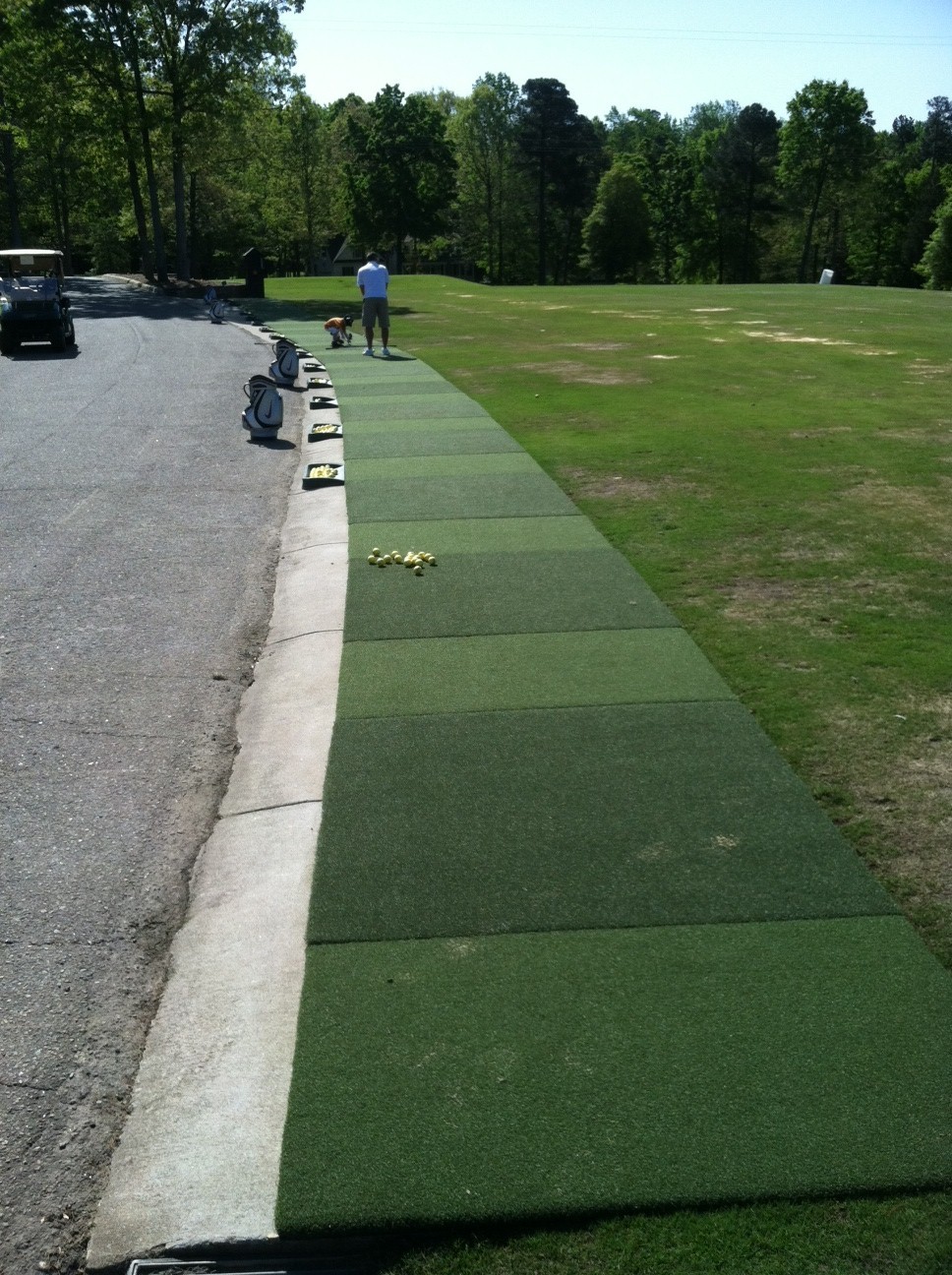
Tee Line Construction Across North Texas
Constructing a tee line that performs reliably across all four North Texas seasons requires attention to both subgrade engineering and surface selection. The DFW Metroplex sits atop the Austin Chalk and Eagle Ford formations, producing soil conditions that range from rocky limestone shelves in areas like McKinney and Allen to heavy black clay in communities such as Irving and Grand Prairie. Tour Greens Dallas adapts every installation to the specific geology of the project site, excavating to an appropriate depth and building a compacted aggregate base that provides long-term stability regardless of the underlying soil composition.
Surface selection focuses on matching the fiber system to anticipated usage patterns. For homeowners building personal practice ranges on their properties, we typically recommend our nylon-based turf systems for their superior club interaction and realistic feel. Commercial facilities processing dozens of golfers each day benefit from configurations that combine dense nylon hitting zones with lower-maintenance surround turf, maximizing performance where it counts while controlling overall project cost. Every turf panel is precision-cut to the project dimensions, stretched over the prepared base, and secured with concealed perimeter anchoring that prevents edge lifting during temperature swings — a critical detail in North Texas, where ground temperatures can shift dramatically between seasons.
- Site-specific subgrade preparation accounts for varied North Texas soil profiles
- Compacted aggregate base resists settling, heaving, and erosion
- Fiber system matched to projected use frequency and golfer volume
- Concealed perimeter anchoring prevents edge lift during temperature fluctuations
- Zero irrigation requirement — compliant with all DFW water restrictions
Engineered for True-to-Life Club Contact
The value of a synthetic tee line lies almost entirely in how accurately it replicates the experience of hitting off manicured natural grass. Tour Greens Dallas achieves this by selecting fiber profiles that compress and spring back in a manner that closely matches the resistance characteristics of dense Bermuda turf. When the clubhead enters the fiber canopy, it encounters enough resistance to provide meaningful feedback — golfers can feel the difference between a clean strike and a fat shot — without the excessive drag that makes some artificial surfaces feel rubbery or unnatural.
Shot-to-shot consistency is where synthetic tee lines truly outperform their natural counterparts. On a natural tee box in the DFW area, the lie changes with every swing: divots, footprints, irrigation patterns, and seasonal dormancy create an unpredictable surface. Our tee lines present an identical lie for every ball, which means every variable a golfer observes in ball flight can be attributed to swing mechanics rather than surface inconsistency. This makes practice more efficient and skill development faster, which is why teaching professionals across North Texas increasingly specify synthetic tee lines for their lesson tee areas.
Golfers who spend extended periods on the range also benefit from the energy-dampening properties of our turf systems. The fiber canopy and cushioned backing work together to absorb a significant portion of the impact force that would otherwise travel up the club shaft. Over a bucket of a hundred balls, the cumulative difference in joint stress is substantial — particularly for older golfers or those recovering from wrist and elbow injuries, a demographic that is growing rapidly across the Metroplex's active retirement communities.
Turf Styles
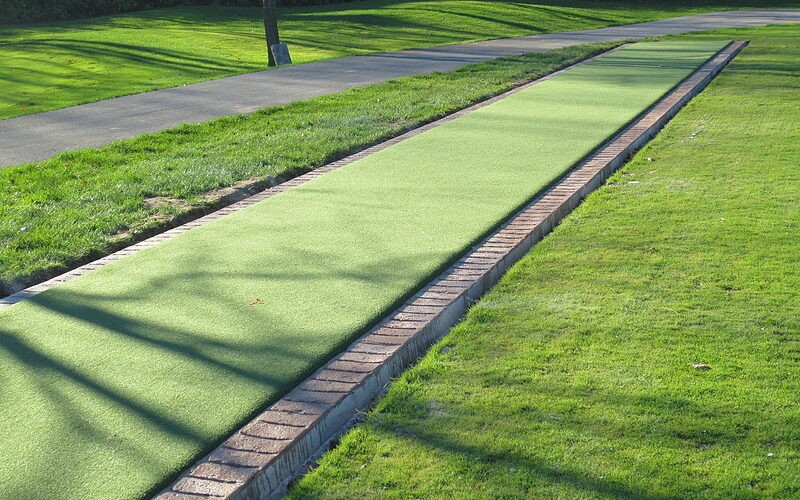
Ultimate Tee Turf
At 110 oz. of nylon fiber per square yard, the Ultimate Tee sets the standard for synthetic tee line performance. DFW golf enthusiasts choose this product for its unmatched density, its capacity to accept and hold real tees securely, and its resistance to fiber breakdown even after tens of thousands of swings.
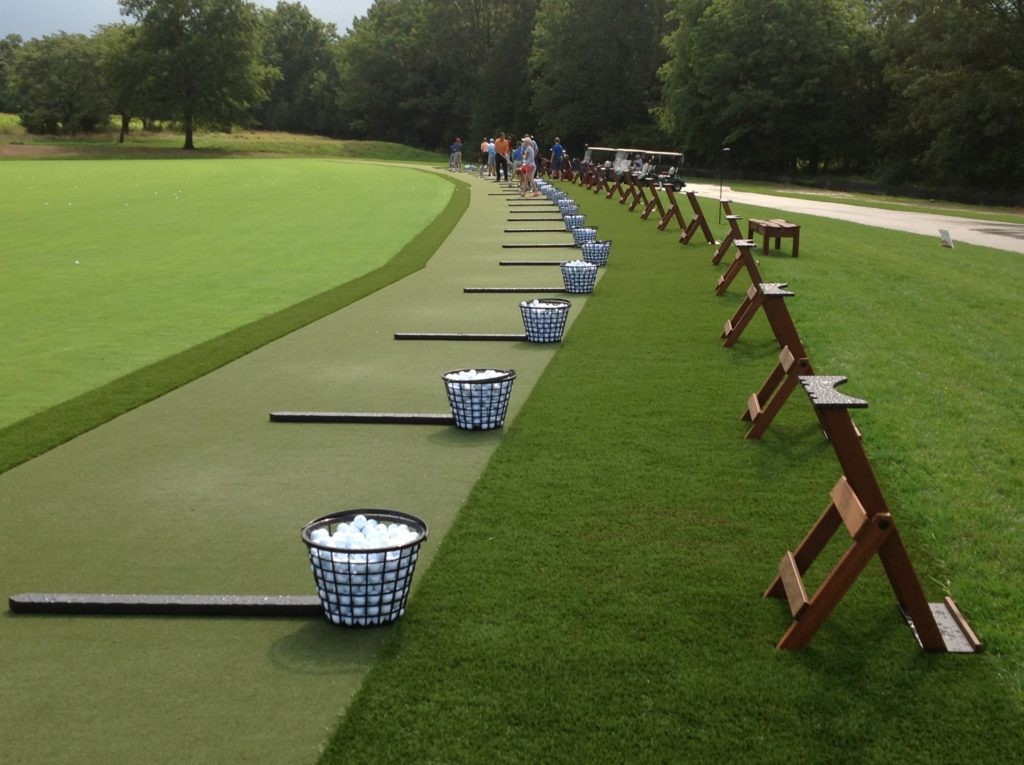
Champion Tee Turf
The Champion Tee uses polypropylene fiber to deliver dependable performance at a reduced price point. It is an outstanding selection for DFW homeowners who play and practice regularly but want to allocate more of their project budget toward other features like putting greens or chipping areas.
Residential and Commercial Tee Line Applications
Tour Greens Dallas designs and installs tee line turf for every scale of project across the Metroplex. Residential clients in neighborhoods throughout Plano, Frisco, McKinney, and Prosper are incorporating tee lines into comprehensive backyard golf environments that include putting greens, short game areas, and hitting nets. Commercial driving ranges across North Texas rely on our tee line systems to replace worn natural tee boxes that were costing thousands of dollars per year in sod replacement, irrigation, and maintenance labor. Private clubs and municipal courses use our turf to create auxiliary practice stations that remain available even when the main tee box is closed for aeration or overseeding. Golf simulator facilities — a rapidly expanding sector throughout the DFW corridor — install our tee line turf as the hitting surface in launch monitor bays, where its consistent fiber height produces the reliable ground contact necessary for accurate swing data. Corporate campuses and high-end office parks in Las Colinas, Legacy West, and Cypress Waters have also adopted tee line turf for executive recreation amenities, offering employees a place to hit a few balls during the workday.
Tee Line Designs
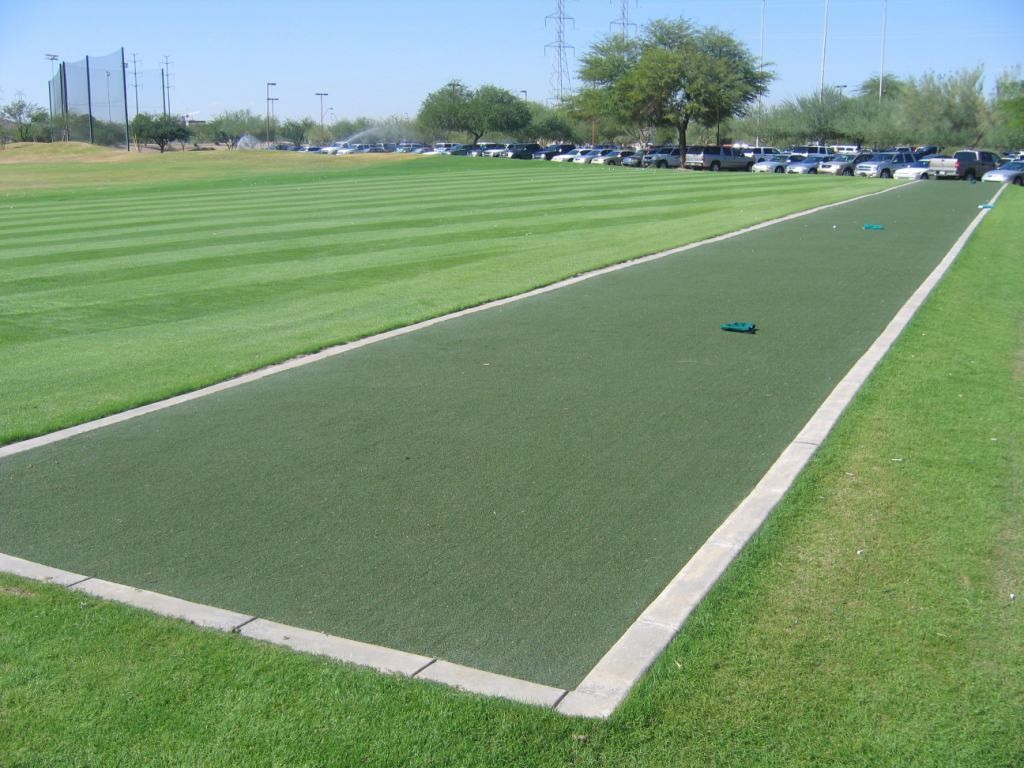
Continuous Tee Line
A single unbroken strip of hitting turf that runs the full width of the practice area. DFW ranges and residential installations favor the continuous layout for its simplicity and the ability to relocate hitting positions to manage wear distribution.
- Ultimate Tee nylon fiber for the softest, most forgiving strike feel
- Champion Tee polypropylene fiber for maximum longevity under traffic
- Open positioning lets golfers set up at any point along the strip
- Seamless construction for a uniform, professional aesthetic
- Cut to any project length with standard widths of 7½' or 5'
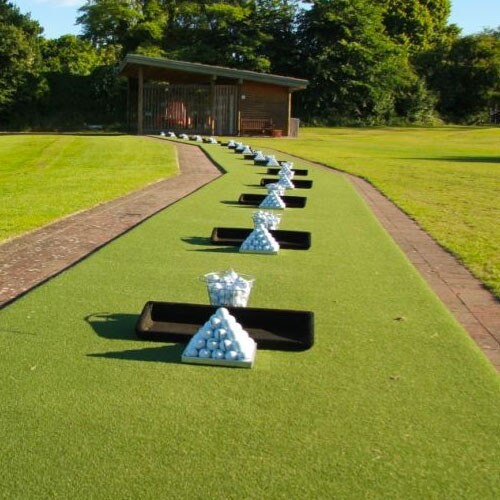
Ultimate Tee Mats
with First Cut Surround
Individual 5'x5' hitting mats framed by a first-cut rough border. This configuration gives each golfer a clearly delineated station, which DFW commercial facilities value for traffic management and consistent daily setup.
- Self-contained 5'x5' hitting mats bordered by manicured surround turf
- Distinct stations eliminate setup ambiguity for staff and golfers alike
- Mats are rotatable to distribute wear and prolong peak performance
- Finished look befitting upscale North Texas residential and club properties

Replaceable Hitting Strip Stations
Narrow nylon hitting strips mounted on stable stance mats offer the most cost-effective tee line format. When a strip wears out, it is swapped for a new one in minutes — keeping the rest of the system intact and fully operational.
- Nylon hitting strips paired with rigid stance mat platforms
- Defined stations support organized, multi-golfer practice sessions
- Stance mats provide the firmest, most secure footing in any synthetic turf product
- Lowest capital cost per station of all tee line configurations
- Replacement strips are stocked locally for rapid turnaround
- Wider 2' strips available to extend the functional lifespan of each station
Keeping Your DFW Tee Line in Peak Condition
One of the strongest selling points of synthetic tee line turf is the dramatic reduction in maintenance compared to natural grass. There is no mowing, fertilizing, aerating, or overseeding involved. However, a few straightforward practices ensure your tee line performs optimally for its full expected lifespan. Cross-brushing the fiber canopy with a stiff-bristle broom on a biweekly basis prevents matting in the primary strike zone and keeps the nylon fibers standing at their designed height. In the DFW Metroplex, where dust and airborne debris are common — especially during spring wind events — a quick rinse with a garden hose after high-wind days keeps the surface clean and free of particulate buildup.
Usage patterns dictate how and when specific sections of a tee line will need attention. The strike zone — the narrow band where the club contacts the surface — wears faster than the stance area because it absorbs direct impact rather than just foot traffic. Rotating golfer positions along a continuous tee line, or rotating individual mats and strips in modular setups, spreads this concentrated wear across more surface area and meaningfully extends replacement intervals. For a typical DFW homeowner practicing three to four times per week, the primary hitting zone maintains excellent performance for six to eight years. High-traffic commercial ranges may cycle through hitting strips every two to four years in the busiest bays while keeping the surrounding turf intact for a decade or more. Call Tour Greens Dallas at 214-367-5313 to arrange a site visit or discuss maintenance planning for your tee line.
Tee Line Turf Questions from DFW Golfers
What does tee line turf cost per square foot in the DFW area?
Tee line turf pricing across the Metroplex depends on the fiber system selected, the size of the installation, and the complexity of base preparation required by site conditions. Our nylon Ultimate Tee turf carries a higher per-square-foot material cost than the polypropylene Champion Tee, but both include full installation labor, base construction, and drainage when you work with Tour Greens Dallas. We provide detailed, itemized proposals after an on-site consultation so there are no surprises. Contact us at 214-367-5313 for a project-specific estimate.
What are the steps in a typical tee line installation?
A standard Tour Greens Dallas tee line installation follows a five-phase process: site assessment and design consultation, excavation and soil preparation, aggregate base construction with drainage integration, turf layout and anchoring, and final inspection with client walkthrough. The entire process typically takes three to five business days for a residential project, though larger commercial installations may require additional time. We coordinate scheduling to minimize disruption to your property or business operations.
What tee accessories work with synthetic tee line turf?
Our nylon tee line surfaces accept standard rubber friction-fit tees, which push into the fiber pile and hold securely during the swing. We also offer recessed tee holders that mount flush with the turf surface for golfers who prefer a fixed tee position. Ball trays, alignment rods, and target markers can all be integrated into the tee line layout during installation or added later. The versatility of the surface means you can use the same accessories you would use on a natural tee box.
How much golfer traffic can a tee line handle per day?
Capacity depends on the turf product and the tee line configuration. A continuous Ultimate Tee line can support upward of fifty to seventy golfers per day when hitting positions are rotated regularly along the length of the strip. Modular stations with replaceable hitting strips can handle thirty to fifty golfers per station per day, with worn strips swapped out as needed to maintain surface quality. For DFW commercial ranges processing high volumes, we design systems with redundancy built in so that sections can be refreshed without taking the entire tee line offline.
What materials are used to manufacture tee line turf?
Tour Greens tee line fibers are produced from either nylon 6,6 or UV-stabilized polypropylene, depending on the product line. These fibers are tufted into a dual-layer polypropylene and polyester backing, then coated with a polyurethane adhesive that locks each fiber in place permanently. The backing incorporates perforation patterns for drainage and is engineered to flex slightly on impact, providing the cushioned response that distinguishes our surfaces from rigid hitting mats. All materials are sourced from manufacturers with documented quality control processes and are tested for UV stability, abrasion resistance, and tensile strength.
Does tee line turf perform differently in winter versus summer?
Synthetic tee line turf maintains consistent playing characteristics across DFW's full range of seasonal temperatures. Unlike natural grass, which goes dormant in winter and softens in summer rain, our fiber systems retain the same pile height, density, and firmness whether the ground temperature is 35 degrees in January or 130 degrees on a July afternoon. The nylon and polypropylene fibers are thermally stable within the temperature range experienced across North Texas, so golfers can expect the same club interaction and ball positioning year-round without seasonal adjustment.